

A key tool in achieving this is the board effectiveness review, a systematic evaluation that provides valuable insights into the function of the board and its various components. When done well, the board effectiveness review is more than just a compliance exercise; it’s an opportunity to understand the dynamics, communication channels and decision-making processes within the boardroom. In this article, we’ll explore what a board effectiveness review entails, what should be included in the process, and most importantly, how to translate the insights gained from the process into actionable steps to enhance board performance.
Table of contents
- What is a board effectiveness review?
- What should be included in a board effectiveness review?
- How to take action following a board effectiveness review
- The importance of prioritising outcomes
What is a board effectiveness review?
Also referred to as a board evaluation or board performance review, a board effectiveness review is a structured evaluation of the performance and efficiency of a board of directors. When conducted with a thorough lens, it extends beyond regulatory compliance and financial performance to delve into the interpersonal relationships, decision-making processes and overall effectiveness of the board. This review shouldn’t be a one-time event, but a recurring annual process, allowing the board to adapt to changing circumstances and continuously improve.
The primary goal of a board effectiveness review is to identify strengths and opportunities for improvement within the board’s operations and dynamics. This involves assessing the skills and competencies of individual board members (often by completing a board skills matrix around the same time), evaluating the effectiveness of board committees, reviewing the relationship between the board and management, and scrutinising the overall governance structure. By doing so, organisations can pinpoint areas that require enhancement and implement changes that will contribute to a more effective and responsive board.
What should be included in a board effectiveness review?
A board effectiveness review should cover a number of areas that take into account the size of the board and the maturity of the organisation. Understanding the key objectives prior to undertaking the review is a critical step to ensuring the review can be a catalyst for meaningful change.
Some of the areas we commonly see included in a board effectiveness review are listed below:
- Board Composition: People, capability, renewal, selection, skills and diversity.
- Chair Leadership: Relationships, planning, facilitation, meeting conduct, synthesis of debate, availability and readiness.
- Strategy: Engagement with organisational strategy, including current state of strategy, the process, priorities and time allocation.
- Monitoring Performance: Oversight of the organisation’s performance, expenditure, delivery, prioritisation, returns and alignment.
- Risk Management: Risk awareness, risk frameworks and risk appetite.
- Board Committees: Committee structure, individual committee effectiveness, committee leadership, committee composition and the interface between committees and the board.
- Board Culture: Behaviours, preparation, robustness of debate and board dysfunction.
- Board/Management Relationship: Engagement between board and management, management transparency, information disclosure, boundaries, guidance and management receptivity to board input.
- Board Processes and Papers: Board papers (quality, format and timeliness), minutes, matters arising and supporting board logistics.
- Talent, Succession and Remuneration: Executive remuneration, performance oversight and talent pipelines.
- Stakeholder Management: Board engagement with key stakeholders, including reputation management, communication, transparency, and planning/framework.
To support boards of all sizes, BoardOutlook has made available a library of board evaluation templates for those looking to understand the types of questions that should be included relating to the above areas. Designed to help boards get started on their continuous improvement journey, they are a sample of a BoardOutlook board evaluation diagnostic.
 How to take action following a board effectiveness review
Conducting a board effectiveness review is only the first step when it comes to board performance. The real value lies in translating the insights gained from the review into concrete actions. Some of the steps that a board can take following a review include:
Sensemaking
Do all directors understand the context of the results? Can they relate the data to their experiences? This should be done before the board meeting to ensure everyone comes prepared and can have a healthy, in-depth discussion.
Impact assessment
Evaluating the impact of the identified issues is critical. What are the current and potential future consequences of inaction?
Action planning
Based on identified issues of the board effectiveness review, the board should develop action plans for improvement, including potential alternatives. Responsibilities should be assigned for implementation, as well as clear timelines.
Training and development
If the board effectiveness review reveals gaps in skills or knowledge among board members, a potential solution could be to invest in training and development programs. Continuous learning ensures that the board remains up-to-date with industry trends and regulatory changes.
Monitoring progress
Establish a system for regularly monitoring the progress of the action plans. Regular check-ins during board meetings can provide updates on the implementation of initiatives and allow for adjustments if necessary.
The importance of prioritising outcomes
In some cases a board effectiveness review can lead to a significant number of insights. While it’s noble to want to resolve every challenge identified, for most boards it’s more realistic to focus on quick wins, as well as one or two core challenges. This ensures meaningful action can be taken following the review, and is more likely to lead to the next review showing positive change in these areas.
BoardOutlook’s purpose-built board evaluation software includes a prioritisation framework, which is completed by individuals at the end of the diagnostic. This framework allows individuals to select up to three important ‘deeper discussions’ that the board should prioritise over the coming six months. It also asks for up to three ‘quick wins’ that the board can tick off to gain momentum.
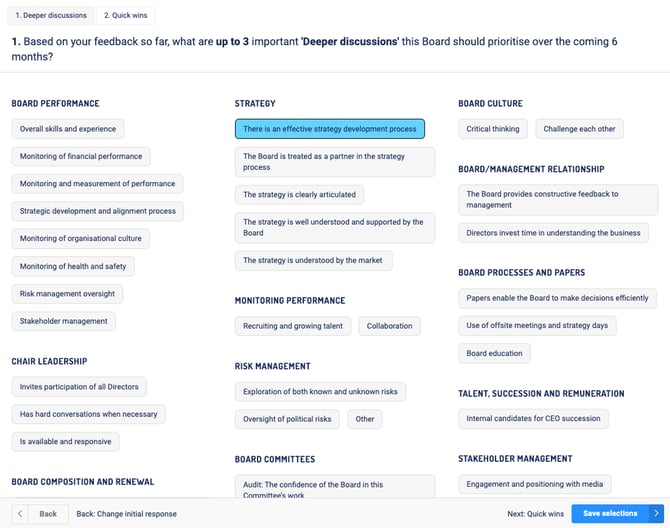
Prioritisation frameworks are beneficial in the following ways:
Targets changeable issues
Naturally directs attention to issues within the board’s capacity to change.
Optimises resources
Allocates resources efficiently, focusing on initiatives that will have the greatest impact.
Demonstrates accountability
By clearly defining desired outcomes, the board showcases its dedication to continuous improvement.
Builds stakeholder confidence
Actively working towards improvements instil confidence in stakeholders, showcasing the board’s commitment to long-term success.
Catalyses positive change
Enables the board to focus its energy, creating a ripple effect throughout the organisation.
Ready to start your board effectiveness review?
A board effectiveness review is a powerful tool for ensuring that a board operates at its full potential. The process involves a thorough examination of individual and collective board performance, committee effectiveness and overall dynamics within the boardroom. However, the true value lies in the ability to translate these insights into actionable steps that lead to positive change. Prioritising outcomes is the key to ensuring that the board’s efforts align with the organisation’s purpose, ultimately contributing to sustained success and stakeholder confidence.